The Checker Shadow illusion (Fig 1) is a an optical illusion consisting of an angled checkerboard of light and dark squares and a green cylinder casting a shadow. Region A appears to be darker than region B, even though they are the exact same shade. The illusion was published by Edward H. Adelson, professor of vision science at MIT, in 1995.[1]
Adelson's illusion is a famous optical contrast illusions where the perceived shade of a region depends on the shade of the surrounding regions.[2] For example, a gray square of average intensity will appear lighter when surrounded by a thick dark border and darker with a lighter border.. In the Checker Shadow Illusion, regions A is surrounded by lighter squares making it appear darker, and region B by darker squares making it appear lighter. Adelson's illusion is enhanced by the pattern of alternating dark and light diagonals, the fuzzy border created by the shadow caste by the green cylinder, and the angle from which the checkerboard is viewed.[1]
Adelson provides a simple proof of his illusion (Fig 2). Here regions A and B are bordered by two parallel stripes of the same shade of gray proving the illusion.[1] Some viewers, however, may perceive a false gradation of intensity within the shadow area making region B still appear lighter than region A.
Other proofs suggested by Adelson include checking the color code of the relevant pixels on a computer or using intensity measurement tools to test the intensity of printed images. Adelson also discusses cutting up or framing the two regions to prove the illusion [1]
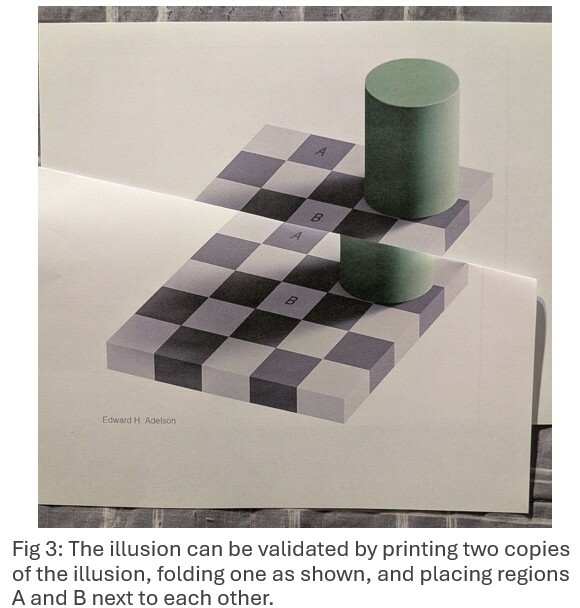
A simple way to demonstrate and prove the Illusion is shown in Figure 3. Start by printing two copies of the image. Next, fold one copy along the top edge of region A, then place it next to region B of the unfolded copy. Region A and B now clearly appear to be the same shade - the illusion is broken. Printing two copies of the image provides a fun way to share the illusion with family members and friends of all ages.
Additional information about the Checker Shadow Illusion and other contrast optical illusions are found in the references below.
References